
Hail, wind and insurance claims
Storm and hail damage, and help with insurance claims
We document what a storm did to your roof, explain it plainly, and give you photos and a written scope. Your insurer decides coverage. Colorado law sets firm rules for contractors in this process, and you should know them.
- Hail seasonRoughly mid-April to mid-September in Colorado
- Your insurer decidesContractors document; insurers determine coverage
- DeductiblesContractors may not pay, waive or rebate them
Hail on the Front Range
Colorado's damaging hail season is generally considered to run from mid-April to mid-September, and the Front Range lies in the region often called "Hail Alley" [S9]. Storms tend to build in the afternoon and can be narrow: one side of a street can be hit hard while the next block over is untouched. That is why a neighbor's claim tells you little about your own roof.
What hail and wind damage look like
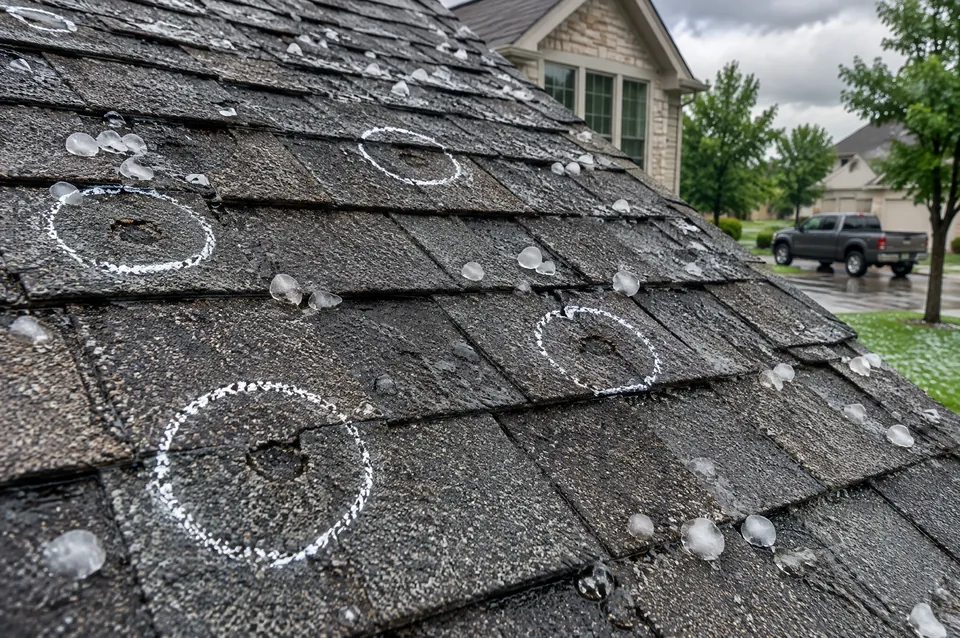
- Asphalt shingles: dark spots where granules were knocked off, soft bruises that give under thumb pressure, or cracked mats. Fresh hits often look shinier than the surrounding surface.
- Soft metals: dents in gutters, downspouts, vent caps and flashing are useful evidence of hail size and direction, even when they are cosmetic.
- Tile: cracked or broken pieces, sometimes hidden under intact tiles above them.
- Wind: creased or missing tabs, lifted ridge caps, and debris impacts.
Not every mark is hail. Blistering, foot traffic, manufacturing flaws and normal wear can look similar from the ground. Careful documentation separates them, and that matters when an adjuster reviews the file.
After a storm: steps the Division of Insurance recommends
The Colorado Division of Insurance has published consumer tips after metro Denver hailstorms [S8]. In summary:
- Contact your insurer promptly to report the damage.
- Photograph damage when it is safe to do so.
- Take reasonable steps to prevent further damage, such as tarping.
- Check your deductible. Many policies use a percentage deductible for wind and hail, for example 1%, 2% or 5% of the dwelling coverage, and damage that costs less than the deductible is not paid.
- Ask for an itemized settlement, and if the claim is denied, ask for the denial in writing with the policy language it relies on.
- Expect estimates to change as work uncovers more; supplemental requests go to the insurer.
- Be careful with door-to-door solicitation.
- Public adjusters are licensed by the Division of Insurance, and you are not required to hire one.
Insurance claim help: what we can and cannot do
What we can do
- Inspect and document the roof's condition with dated photos.
- Explain what we see, including what we believe is storm-related and what is ordinary wear.
- Provide a written scope and estimate you can share with your insurer.
- When you have signed a contract with us, discuss the scope of repairs with your insurer on your behalf, as Colorado law permits [S7].
What we will not do
- Promise or imply that a claim will be approved, or describe any roof as "free".
- Act as your public adjuster. Colorado law prohibits roofing contractors from doing so [S7]. We do not negotiate your settlement.
- Pay, waive or rebate any part of your deductible.

Consumer warning: deductible offers are illegal
Colorado law says a roofing contractor may not advertise or promise to pay, waive or rebate any part of an insurance deductible [S7]. If someone offers to "cover" or "absorb" your deductible, or to inflate an estimate to make it disappear, treat that as a reason to walk away. The deductible is your share of the loss under your policy.
Your contract rights in Colorado
Before roofing work on residential property, Colorado requires a signed written contract that includes, among other things, the scope of work, materials, approximate dates and cost, the contractor's contact information, the contractor's surety or liability insurer if applicable, the cancellation and refund policy, and a statement about the deductible. You may rescind the contract within 72 hours after signing it. Payments are to be held in trust until materials are delivered or the majority of the work is performed [S5].
If insurance proceeds will pay for the work, you may also rescind within 72 hours after receiving written notice from your insurer that the claim is denied in whole or in part, with limits for unforeseeable supplemental work [S6]. Read the statutes themselves for the exact wording; this summary is not legal advice.
Storm-chaser cautions
- Pressure to sign on the doorstep, the same day, before your insurer has inspected.
- Any offer involving your deductible.
- A contract that assigns your claim or lets the contractor "deal with the insurance" for you.
- No local contact details, or a license you cannot verify. Denver issues its own contractor licenses and does not accept licenses from other counties or states [S4]; other cities and counties have their own rules.
Taking a few days to get a second opinion is reasonable. How we research these pages.
Questions people ask
- Will my insurance pay for a new roof after hail?
Only your insurer can answer that, under your policy. Coverage depends on the damage, your policy terms and your deductible. We can document the roof and give you a written scope; we cannot predict or promise the decision. We are a contractor, not your insurer or public adjuster.
- Should I call my insurer or a roofer first?
The Division of Insurance advises contacting your insurer promptly. Many owners also get an independent inspection so they understand the damage before the adjuster visits. There is no requirement to sign anything with a contractor to get an inspection.
- What if the adjuster misses damage you documented?
You can ask your insurer for an itemized settlement and the reasons behind it, and supplemental requests are made to the insurer as work proceeds. When we are under contract, we may discuss the scope of repairs with the insurer; we cannot negotiate the claim for you.
Sources
- S4 City and County of Denver, Community Planning and Development: Contractor Licensing
- S5 Colorado Revised Statutes 6-22-103: Roofing contractor written contract (colorado.public.law)
- S6 Colorado Revised Statutes 6-22-104: Rescission after insurer denial (colorado.public.law)
- S7 Colorado Revised Statutes 6-22-105: Insurance deductible (colorado.public.law)
- S8 Colorado Division of Insurance: Consumer advisory with tips after a metro Denver hailstorm
- S9 Colorado DHSEM / READYColorado: What to do after a hail storm (and no roof scams)
Rules change. Confirm current requirements with Denver Community Planning and Development or your own city or county building department. This is general information, not legal advice. Last reviewed November 2026. How we research these pages.