
Roofing materials
Asphalt shingles in Denver's climate
Asphalt shingles cover most houses in the metro because they are light, familiar to every crew and moderate in cost. Their weak spots are hail bruising and sun-driven aging, and both can be managed.
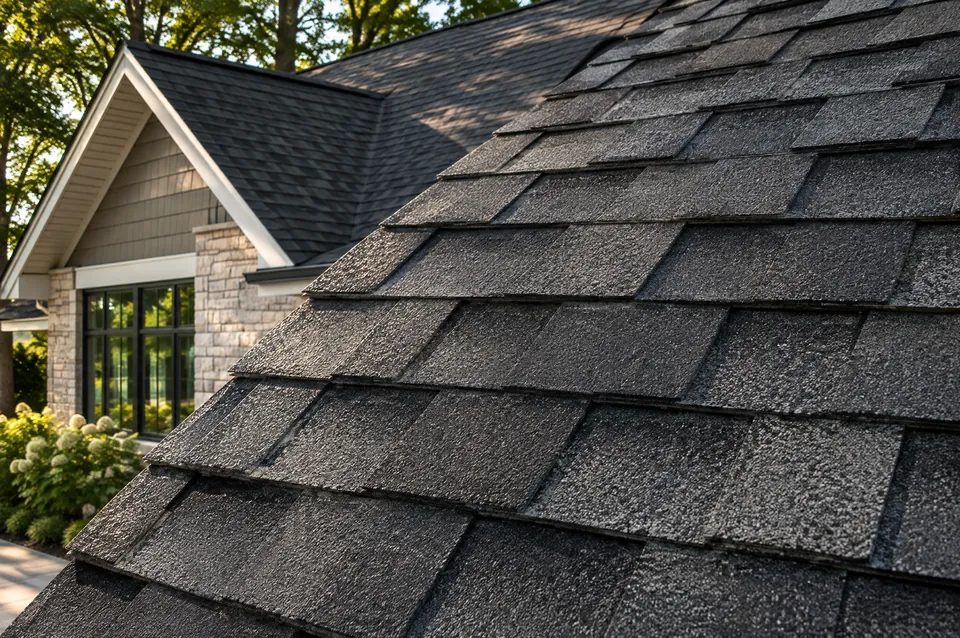
- Types3-tab, architectural, impact-rated
- WindDenver requires a tested wind rating
- Watch forGranule loss and bruised mats after hail
What you are choosing between
An asphalt shingle is a fiberglass mat soaked in asphalt and topped with ceramic-coated mineral granules. The granules give the color, and more importantly they shield the asphalt from sunlight. Three broad kinds are sold:
- Three-tab: a single flat layer with cutouts. Lighter, plainer and less common on new Denver roofs.
- Architectural (dimensional): two or more laminated layers that give a textured, shadowed look and a heavier shingle.
- Impact-rated: usually architectural shingles built with a modified asphalt or reinforced mat and tested under UL 2218; Class 4 is the highest class in that test.
Trade-offs on the Front Range
In their favor
- Light, so they rarely need a structural check on an existing house.
- Suit most steep-slope roofs and complicated shapes with many valleys.
- Easy to repair a few pieces at a time.
- Wide range of colors that satisfy most HOA rules.
Against them
- Hail can knock off granules or fracture the mat, even when damage is hard to see from the ground.
- Sun at altitude dries the asphalt over time once granules thin out.
- Seal strips can let go in strong downslope winds.
- Need a minimum slope; very shallow porch roofs need something else.
Hail and the impact-rating question
A UL 2218 Class 4 label means a sample survived the standard's steel-ball drop test without cracking through. In real storms, rated shingles still bruise, mark and lose granules; they tend to resist splitting better than standard shingles. Whether the extra cost pays off depends on how long you plan to stay, how exposed the house is, and, if you want to factor it in, what your own insurer says about impact-rated roofs. Ask your insurer directly; do not rely on a sales pitch for that answer.
Sun, altitude and color
UV exposure climbs about 2% for every 1,000 feet of elevation [S10], so Denver shingles see noticeably more of it than the same product at the coast. Darker colors run hotter in summer. Good attic ventilation keeps the deck cooler from below, which helps any shingle age more slowly.
Wind ratings and installation
Denver requires shingles to be tested and labeled for wind resistance under ASTM D7158 or D3161, with minimum ratings by wind zone [S2]. Ratings assume the manufacturer's nailing pattern and starter strips are followed. Ask which pattern the crew will use and whether it matches the rating on the package.
Freeze-thaw details
Shingles shed water downhill; ice dams push it uphill. A self-adhering ice barrier along the eaves and in valleys is the main defense, along with balanced ventilation so the roof surface stays closer to outdoor temperature.
Questions to ask about a shingle proposal
- Exact product line and color, with the spec sheet attached.
- Impact class, if any, and wind rating.
- Underlayment type and how far the ice barrier runs.
- Manufacturer warranty terms and the contractor's workmanship terms, both in writing. Service life varies by product; ask for the manufacturer's spec.
Questions people ask
- How can I tell if hail damaged my shingles from the ground?
Often you cannot. Look for dented gutters, downspouts and vent caps, and for granules piled at downspout outlets. Those suggest the roof should be looked at up close. Do not climb onto the roof yourself after a storm.
- Are architectural shingles worth it over 3-tab?
For most Denver homes, yes: they are heavier, tend to carry higher wind ratings, and look better on the street. Three-tab products are also becoming harder to match for repairs.
- Do impact-rated shingles lower insurance premiums?
Some insurers offer adjustments and some do not; policies and programs change. Ask your own insurer before you decide, and get the answer in writing if it affects your choice.
Sources
- S2 City and County of Denver: Roofing Guidelines and Checklist (PDF; older code edition)
- S10 U.S. EPA: A Guide to the UV Index (PDF)
Rules change. Confirm current requirements with Denver Community Planning and Development or your own city or county building department. This is general information, not legal advice. Last reviewed November 2026. How we research these pages.