
Full tear-off and new roof system
Roof replacement in Denver
Replacement is the right call when repairs keep chasing the same problems or the surface has worn out across the whole roof. Here is how to tell, what the work involves, and how to compare bids.
- Repair or replaceLook at the whole roof, not the one leak
- Wind ratingDenver requires shingles tested for wind resistance
- CloseoutA permitted reroof ends with a city final inspection
When replacement makes more sense than repair
One cracked vent boot or a few torn tabs is a repair. Replacement starts to make sense when the problems are spread out: granule loss across most slopes, shingles that have gone brittle and crack when bent, repeated leaks in different places, or hail bruising scattered over the whole surface. Age alone is a weak signal; two roofs installed the same year can be in very different shape depending on ventilation, color, orientation and how many storms they have taken.
There is also a code angle. Denver's roofing guide says that, for buildings under 25,000 square feet, repairs covering more than 10% of the roof area or two roofing squares, whichever is smaller, need a permit, and that partial slopes may not be replaced, although a partial roof that ends at a natural edge may be [S2]. That guide dates to an older code edition, so confirm the current rule, but it explains why a patch sometimes grows into a full slope.
What a replacement involves
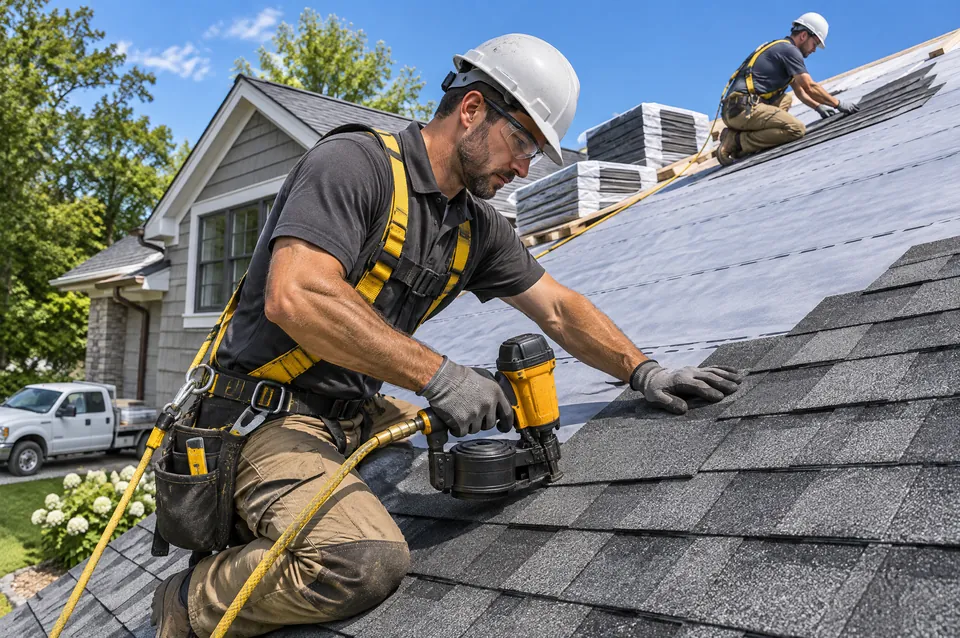
- Protection and tear-off. Landscaping, siding and driveways are covered; old roofing is stripped to the deck and hauled away.
- Deck check. With the deck exposed, soft or delaminated sheathing can be found and replaced. This is the one part of the job no one can fully price in advance.
- Underlayment and ice barrier. A water-resistant layer goes down over the deck, with self-adhering ice barrier at the eaves and in valleys where freeze-thaw cycles push meltwater uphill.
- Flashing and ventilation. Wall, chimney and valley flashing, drip edge, pipe boots and roof vents are replaced or re-set rather than reused by default.
- New covering. Shingles, metal, tile or membrane installed to the manufacturer's instructions.
- Inspection and cleanup. Magnetic sweep for nails, then the city's final inspection where a permit applies; a final inspection is part of a Denver roofing permit [S2].
Front Range details that matter at replacement time
Denver requires shingles to be tested and labeled for wind resistance under ASTM D7158 or D3161, and it has set minimum wind ratings by zone [S2]; ask which rating the proposed shingle carries and confirm it against current city requirements. Replacement is also the cheapest moment to fix attic ventilation, because intake and exhaust can be balanced while the roof is open. In hail country, it is the moment to decide whether an impact-rated product is worth the difference for your house.
Older homes can hide asbestos in roofing or roofing cement. Denver's guide points owners to Colorado Department of Public Health and Environment requirements for asbestos inspection and removal, and proof may be requested [S2]. If testing is needed, it happens before tear-off.
Our scope and its limits
Our written estimate lists each component above, the product names and colors you choose, and how deck replacement is priced if rotten boards turn up. We do not promise a lifespan for any product; service life varies by product and exposure, so ask for the manufacturer's spec and warranty terms in writing. We do not alter framing without an engineer's input.
Comparing replacement bids
- Is it a full tear-off to the deck, and how is replacement decking priced per sheet?
- Which underlayment, how much ice barrier, and where?
- Is all flashing new, or is some reused?
- What wind rating and impact rating does the shingle carry?
- Who pulls the permit, and does the price include the final inspection?
Bids that look far apart often differ on exactly these lines.
Questions people ask
- How long does a typical house re-roof take?
Many single-family re-roofs are on-site for a short number of working days, but size, steepness, material, weather and deck repairs all change that. Afternoon storms in summer and cold snaps in winter can pause work. Your estimate should give approximate dates, which Colorado contracts for residential roofing must include [S5].
- Can new shingles go over the old layer to save money?
Whether an overlay is allowed depends on the code in force and the existing roof. Even where it is allowed, it hides the deck, adds weight and can shorten the life of the new layer. Our estimates assume full removal so the deck can be seen and repaired.
- Do I need to be home during the tear-off?
Not usually, but plan for noise and vibration, keep vehicles out of the drive, and take fragile items off walls on the top floor. We will need access to outlets and the attic if ventilation work is in the scope.
Sources
- S2 City and County of Denver: Roofing Guidelines and Checklist (PDF; older code edition)
- S5 Colorado Revised Statutes 6-22-103: Roofing contractor written contract (colorado.public.law)
Rules change. Confirm current requirements with Denver Community Planning and Development or your own city or county building department. This is general information, not legal advice. Last reviewed November 2026. How we research these pages.